
Most SEO writing about HVAC treats the category as one thing. There’s an article called “HVAC SEO Best Practices for 2026,” and underneath it is the same list everyone has written for the last five years: optimize your Google Business Profile, build city pages, get reviews, watch your Core Web Vitals.
The advice isn’t wrong. It just isn’t useful, because HVAC SEO in one country is not the same game as HVAC SEO in another country. The SERPs are structured differently. The competitive set is different. The trust signals are different. Even the terminology is different. A playbook tuned for one market doesn’t just underperform in another -large chunks of it stop being relevant.
I wanted to show this concretely, with real examples. So I spent a day comparing what an HVAC firm has to do to rank in Brisbane to what an HVAC firm has to do to rank in Houston. Two markets with similar populations (Brisbane metro ~2.6 million, Houston metro ~7 million), both with hot subtropical climates, both with serious year-round demand for air conditioning service. On paper, similar markets. In practice, the SEO game in each is built around a different problem.
Here’s what I found, and what it means for any service business owner -or any agency -who assumes their playbook from one market will transfer to another.
How I compared the two markets
Before going further, for new SEOs learning about HVAC niche, HVAC stands for – Heating, ventilation, and air conditioning.
So… Here’s what I did to compare the two market (obviously took help of AI):
- Ran the queries a real customer would run: “air conditioning Brisbane,” “air conditioning repair Brisbane,” “AC repair Houston,” “HVAC Houston.”
- Documented the SERP composition above the fold for each market.
- Sampled the homepages of firms that ranked: ~6 Brisbane HVAC businesses, ~6 Houston HVAC businesses.
- Inspected the actual HTML, meta tags, navigation depth, service mix, trust signals, and payment options on each.
- Cross-referenced market-structure data (aggregator dominance, LSA penetration, certification systems) from public sources.
Where I name a specific business in this piece (Metropolitan Air Conditioning, Air Tech of Houston, Tritech, and so on), I have personally checked the observation. Where I generalize (“most Houston HVAC firms,” “almost every Brisbane site”), I am presenting a pattern, not a precise percentage.
Note: The SERP changes over time so the actual results could differ. To research, I’ve used “Valentin App” with local English language for location.
Seven structural differences that decide who ranks
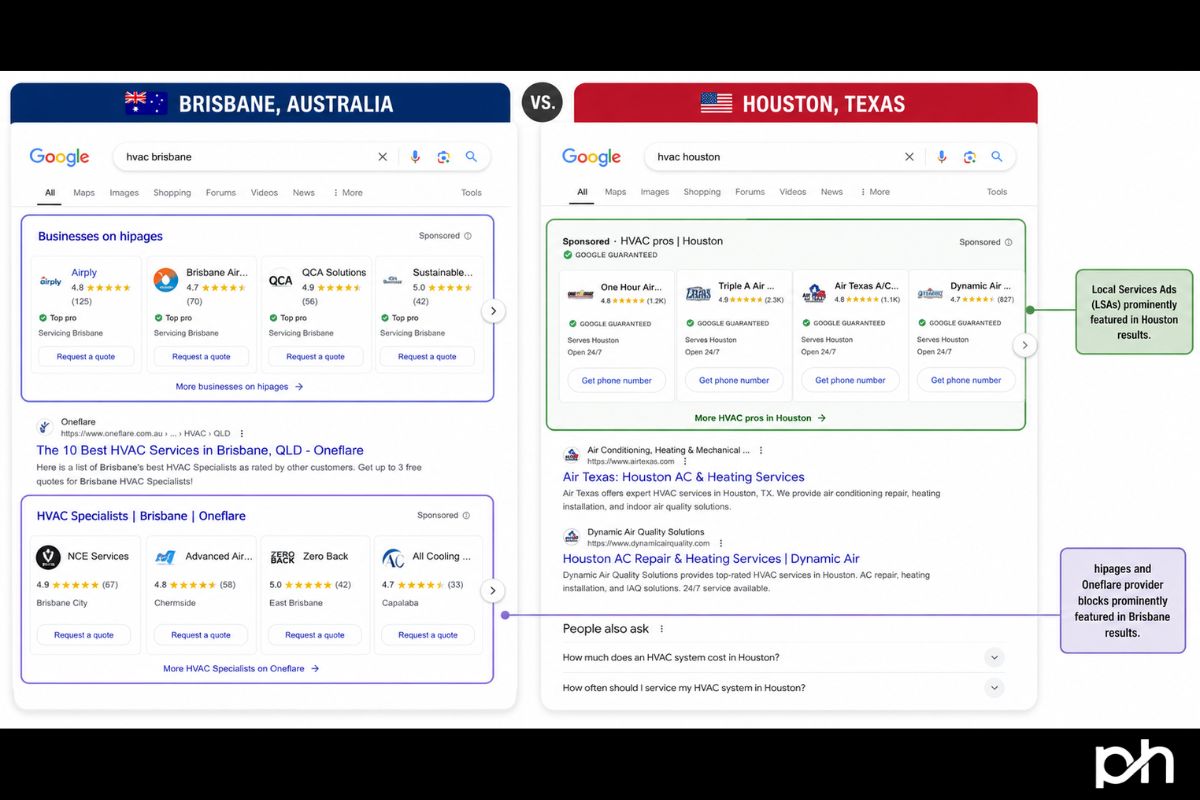
1. The Brisbane SERP is dominated by aggregators. The Houston SERP is dominated by LSAs.
This is the difference that drives everything else. When you run an HVAC query in Brisbane, the organic top 10 will typically include hipages, Oneflare, and ServiceSeeking -the three big Australian tradie marketplaces. According to Ahrefs, hipages.com.au has a Domain Rating of around 79, Oneflare around 75, and ServiceSeeking around 71. Those numbers mean those sites have, in SEO terms, three to four orders of magnitude more authority than the average independent Brisbane HVAC business.
A Brisbane HVAC firm that ranks #1 organically is genuinely #1 -but for many queries, the visible top 5 results are: hipages, Oneflare, ServiceSeeking, the local pack, and then the firm. The aggregators don’t just compete with the firm. They harvest the upstream demand, then sell those leads back to firms (including the same firms) for a per-lead fee.
Houston’s SERP is structured differently. The aggregators (Yelp, Angi, HomeAdvisor) are present but they aren’t dominant the way hipages is. What dominates is paid Google real estate: Local Services Ads at the very top with the Google Screened badge, then standard Google Ads, then the local pack, then organic. For a high-intent query like “AC repair Houston,” a Houston HVAC firm’s main competition above the fold is not other firms’ SEO -it’s other firms’ LSA bids.
This single difference rewrites the strategic question. In Brisbane, the question is: how do I get past the aggregators to be seen? In Houston, the question is: do I bid for the LSA position, win the 3-pack on proximity and reviews, or chase organic -and how much of each?
2. The competitive set is structured differently
In Houston, the larger HVAC operations bundle services: HVAC plus heating plus plumbing plus electrical plus generators, all under one brand. Air Tech of Houston is a clean example. Its homepage navigation includes Air Conditioning, Heating, Generators, Plumbing, and Electrical as top-level menus, with another 20+ specific service pages beneath each. A single Houston firm site can carry 60+ service pages and several thousand internal links.
This bundling is a US-specific business pattern. It works because residential customers value one-call convenience, because the licensing requirements in Texas allow combined-trade operations under unified branding, and because the SEO benefits of one big domain accumulating authority across multiple service categories are substantial.
In Brisbane, the same parent operator typically splits the brands. Metropolitan Air Conditioning, Metropolitan Plumbing, and Metropolitan Electrical are sister sites under one parent, but each is a separate domain with its own SEO. The split is driven by Australian licensing requirements and by consumer expectations: Australians expect a plumber to be a plumber and an aircon tech to be an aircon tech.
The implication for SEO: a Brisbane HVAC site is leaner -often 15–30 service pages -competing in a SERP where aggregators have thousands of pages. A Houston HVAC site is sprawling -60+ service pages -competing in a SERP where the aggregators are weaker but the LSA bids are brutal.
3. The service mix is driven by climate, not best practices
Look at the homepage navigation of a Brisbane HVAC firm versus a Houston HVAC firm. The categories aren’t translatable.
Brisbane (from Metropolitan Air Conditioning’s Brisbane page):
- Cooling: Split Systems, Multi Head Split Systems, Cassette Air Conditioners, Reverse Cycle Air Conditioning, Evaporative Cooling, Ducted Reverse Cycle, Inverter Air Conditioning, Window Air Conditioners.
- Heating: Split System Heating, Gas Ducted Heating, Ducted Reverse Cycle, Gas Heating, Space Heaters, Hydronic Heating, Flued Gas Heater, Gas Log Fire, Wall Furnace.
Houston (from Air Tech of Houston):
- Air Conditioning: AC Emergency, AC Installation, AC Repair, AC Tune-Up, Ductless AC, Indoor Air Quality, Air Ducts, Attic Insulation, Thermostats.
- Heating: Heating Emergency, Furnace Installation, Furnace Repair, Furnace Tune-Up, Heat Pumps.
The Brisbane site is full of categories that mean nothing to a Houston searcher: evaporative cooling (useful in dry climates, mostly irrelevant in humid Houston), hydronic heating (rare in Texas residential), gas log fires (almost never installed in subtropical Texas homes). The Houston site has categories that mean nothing in Brisbane: attic insulation (residential attics work differently in AU), gas furnaces (rare in Brisbane’s mild winters).
You cannot lift one navigation and drop it into the other market. The pages would either target zero search volume or signal to Google that the site is incoherent for its claimed location.
4. The terminology is different. Google knows.
A Brisbane customer searches for “air con” more than “AC.” A Houston customer is the reverse. “Reverse cycle” is the dominant term in Australia for what Americans call a “heat pump.” “Air con regas” is a common query in Australia for what Americans would phrase as “AC refrigerant recharge.” Service is called “service” in Australia and a “tune-up” in the US.
This isn’t just stylistic. Google’s NLP layer associates terminology with markets. A site whose copy reads “reverse cycle” throughout signals Australia to Google. A site using “heat pump” and “AC tune-up” signals North America. Cross-market sites that try to serve both with the same content end up signalling neither cleanly, and they rank worse in both.
5. The trust signals are different -and not interchangeable
What signals trust to a Brisbane homeowner:
- ABN (Australian Business Number) displayed in footer.
- Electrical and refrigeration licences with state-specific numbers (Queensland in Brisbane’s case).
- Warranty agent status for major brands (Daikin, Mitsubishi Electric, Fujitsu -which dominate the Australian market).
- Master Electricians Australia or NECA membership.
- Zip Pay and Afterpay payment options (BNPL is mainstream in Australian service businesses).
What signals trust to a Houston homeowner:
- NATE certification (North American Technician Excellence).
- TACL license number (Texas-specific HVAC contractor licence).
- BBB A+ rating with year-of-accreditation.
- Better Business Bureau, Angi, HomeAdvisor screened badges.
- Financing partner badges (GreenSky, Synchrony) for big-ticket installs.
A Brisbane site that puts “NATE Certified Technicians” on its homepage signals confusion at best. A Houston site that puts “Daikin Warranty Agent” as a primary trust badge means little to a Houston searcher who has never heard of the certification structure that matters in Brisbane. The trust stack doesn’t translate any more than the service stack does.
6. The Google products available in each market are different
Google Local Services Ads launched in the US in 2017 and have expanded aggressively into service categories. HVAC LSAs have been mature in Houston for years; they sit above all organic results, and every serious HVAC business in the market is bidding. Industry guides suggest US HVAC LSA leads cost in a wide range depending on market and category quality controls, with HVAC consistently appearing in the most competitive LSA categories tracked by lead-generation platforms.
Google rolled out LSAs in Australia later, and as of early 2026 the category coverage is narrower and the competitive intensity is lower. The Google Guaranteed badge still appears at the top of some Brisbane SERPs, but the position isn’t yet the default-dominant fixture it is in Houston. That gap is closing -Google has expanded the eligible categories and made setup easier for Australian small businesses through 2025 -but right now, a Brisbane HVAC firm can still rank organically into a SERP where LSAs occupy less real estate than they do in Houston.
AI Overviews are also rolling out differently. Both markets see them, but they appear more often on US queries than on equivalent Australian queries today, and Google’s local pack behaviour differs between the two markets in subtle ways that change which signals matter most.
7. The off-page ecosystem is different
Where backlinks come from looks completely different in each market.
Useful link sources for a Brisbane HVAC firm include:
- hipages, Oneflare, ServiceSeeking listings (counts as a citation more than a backlink, but matters).
- Yellow Pages Australia, True Local.
- State and local council business listings (Brisbane City Council, Queensland Government supplier registries).
- Industry associations: AIRAH (Australian Institute of Refrigeration, Air Conditioning and Heating), ARCtick certification listing.
- Local news (Brisbane Times, Courier Mail community sections).
Useful link sources for a Houston HVAC firm include:
- Angi (formerly Angie’s List) and HomeAdvisor pro profiles.
- Yelp, BBB Houston, Nextdoor business listings.
- Greater Houston Partnership, Houston Chamber of Commerce.
- Industry: ACCA (Air Conditioning Contractors of America) and NATE certification directories.
- Local news (Houston Chronicle community sections, neighbourhood blogs).
There is essentially no overlap between these two lists. A Brisbane firm with strong local-link profile would, if airdropped into Houston, show up as a domain with no recognisable American trust signals. The reverse holds.
What happens if you port one playbook to the other market
I want to be honest about how I’m framing this section: this is a hypothetical, not a client case study. I’m describing what I’d expect to happen based on the structural differences I’ve documented above, not reporting an experiment I ran.
Take a top-ranking Brisbane HVAC site and port everything -the navigation, the trust stack, the copy, the off-page profile -to Houston:
- Half the service pages target zero Houston search volume (evaporative cooling, hydronic heating, gas log fires, multi-head split systems).
- The copy mentions “reverse cycle,” “air con,” and “regas” -Google’s NLP layer reads as Australia. The site is unlikely to rank for “AC repair Houston.”
- The 1300 phone number reads as foreign. The Zip Pay badge means nothing.
- No NATE, no TACL number, no BBB rating, no Angi listing -the local trust ecosystem doesn’t recognise this firm.
- No LSA presence -the site is invisible above the fold for most commercial Houston HVAC queries.
- The leaner 20-page navigation underperforms against Houston competitors with 60-page bundled-service sites.
And the reverse, from Houston to Brisbane:
- The HVAC + Plumbing + Electrical bundling under one brand is structurally incompatible with Australian licensing norms. The brand reads as suspicious.
- The 60-page service navigation is overkill for the Brisbane SERP and looks bloated against leaner local competitors.
- US-style “furnace” content is irrelevant in Brisbane’s mild winters.
- The NATE / TACL trust stack means nothing. The financing-partner badges look foreign.
- The aggressive sales-driven hero copy reads as American and underperforms against the more trades-trusted “qualified, reliable, local” tone Brisbane customers prefer.
- The site has no presence on hipages, Oneflare, or ServiceSeeking, so it’s invisible in the Brisbane SERP wherever the aggregators rank -which is most of it.
In both directions, the failure mode is the same: a site that would have ranked well in its home market shows up in the foreign market with most of its trust signals invisible, half its content irrelevant, and no presence in the off-page sources Google uses to evaluate local trust.
Why this matters even if you’re not crossing borders
You may never expand from Brisbane to Houston or back. The reason this comparison matters is broader: every market has its own structure, and the structure decides which SEO tactics actually work.
The same logic that separates Brisbane from Houston also separates:
- Houston from Phoenix (Houston has heavy humidity, Phoenix has dry heat -the service mix is different, the seasonal pattern is different).
- Brisbane from Melbourne (Brisbane is subtropical, Melbourne has real winters -Melbourne firms sell hydronic heating; Brisbane firms barely do).
- A US metro from its surrounding rural counties (LSA density and local-pack competition collapse outside the metro core).
- A new-build suburb from an established suburb in the same metro (the search behaviour, the brand recognition baseline, and the trusted referral sources are all different).
The discipline is the same in every case: don’t start with the tactics. Start with the SERP. What’s actually ranking on the first page for the queries that matter? Who occupies the space above the fold? What trust signals do those sites carry that your site doesn’t?
What to do instead of importing a playbook
When I scope a new client in a market I haven’t worked before, this is the order I work in:
- 1. Map the SERP first. Run the top 10 queries a real customer would run. Document everything above the fold: paid ads, LSAs, AI Overviews, local pack, organic. Note who appears in each layer. The composition of the SERP is the brief.
- 2. Identify the aggregator threat. In every market, some directory or marketplace usually takes a meaningful chunk of the SERP. Knowing which ones, and how much real estate they own, decides whether your strategy is to beat them, partner with them, or accept that they win the top of the funnel and focus on conversion.
- 3. Catalogue local trust signals. Don’t borrow trust signals from another market. Identify the certifications, licences, payment options, and badges that matter in this market. Make them prominent.
- 4. Audit the off-page ecosystem. Build the list of citations and link sources that are actually relevant in this market. Skip anything imported from a generic “top 50 directories” list -most of those are wrong for any specific market.
- 5. Calibrate Google product strategy. Decide where LSAs sit in your plan based on this market’s current LSA density, not last year’s averages. If LSAs dominate the SERP, you’re competing on LSA economics first and organic second. If they don’t, the reverse.
Only after that work is done do tactics start to matter. Page architecture, schema, internal linking, content velocity -all of it is downstream of the market mapping. Tactics borrowed without the mapping work miss the point of what the market is actually rewarding.
The honest take
I see two failure modes recurring in HVAC SEO. The first is firms that hire generalist agencies who pitch “HVAC SEO best practices” as if those exist independent of market. The second is firms that try to grow into a new market by copying what worked in their home market. Both fail for the same reason: SEO isn’t a generic discipline applied to a category. It’s a market-specific discipline that happens to involve a category.
If you’re an HVAC business in Brisbane and you’re being sold an SEO plan that reads like it was written for the US, ask where the aggregators fit. If you’re in Houston and you’re being sold a plan that doesn’t address LSAs, ask where the LSA strategy is. Those two questions alone filter out most of the bad pitches.
I work on local SEO for service businesses in both the US and Australia, with separate playbooks for each market. If you’re expanding across markets or hiring an SEO who claims their generic playbook will work for you anywhere, I’m happy to talk through what to test first. Get in touch via the contact page.