
Most local SEO audit checklists you’ll find online read like they were written for everyone and aimed at no one. Forty-eight items long, half of them irrelevant to your business, with no sense of which ones actually move rankings.
The audit I run before signing a US service-business client is different. It has seven steps. They go in a specific order. And if you’ve never had one done, I can tell you right now – with high confidence – what at least five of those steps are going to flag on your site.
I’m Praphulla Hada. I work as an SEO Strategist and Project Manager, and the businesses I take on are almost all local service operations especially law firms.
Not a generic checklist. Not a list of “30 things to consider.” Seven steps, in order, with the patterns I see repeating across the sites I look at.
If you’re a service business reading this, treat it as a self-diagnosis. You will recognize at least three of these in your own setup.
Step 1: Google Business Profile – the audit starts here, not on your website
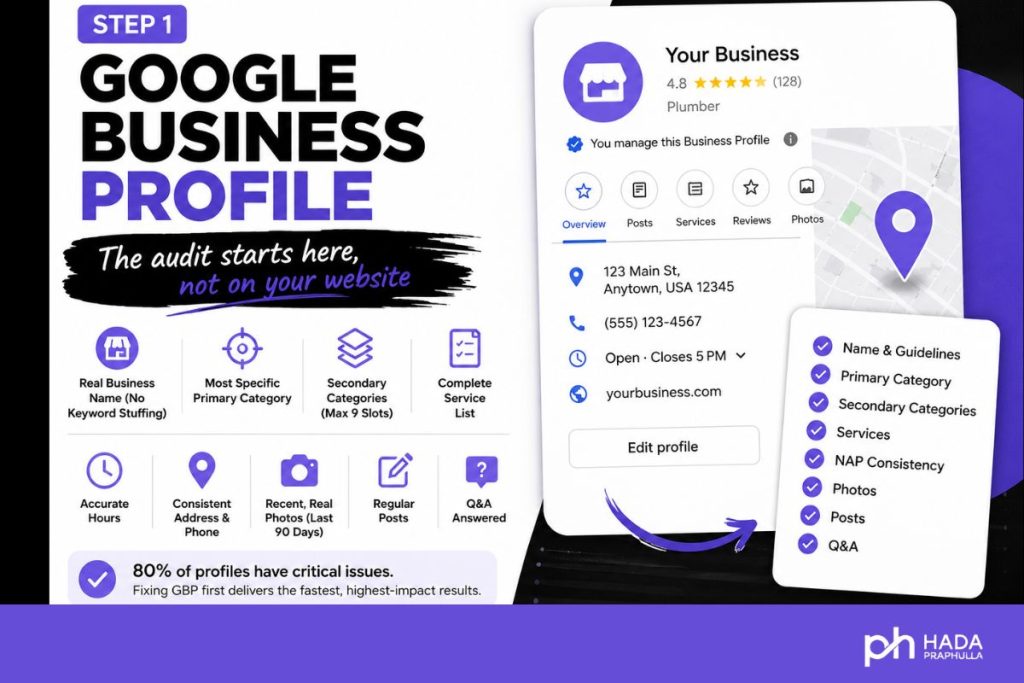
Every audit starts on the Google Business Profile, not the homepage. For most US service-business queries, GBP is now the first surface a customer sees, the data feed Google uses for Maps and the local pack, and the source AI Overviews increasingly pull from. If GBP is broken, no amount of website optimization will save the site.
What I check first:
- Is the business name the real legal name, or has someone stuffed keywords into it? Google has been suspending profiles for keyword stuffing more aggressively through 2026 — this is the single fastest way to lose visibility right now.
- Primary category: is it the most specific category available? “Personal Injury Attorney” beats “Lawyer.” “Plumber” beats “Contractor.”
- Secondary categories: most service businesses use one or two. There are nine slots. Almost no one fills them.
- Service list: empty or generic, when it should be a complete inventory.
- Hours, address format, phone number — looking for anything that doesn’t match the website footer.
- Photos: any from the last 90 days? Real, or stock?
- Posts: when was the last one published?
- Q&A section: has the owner answered any questions, or is it filled with unanswered ones?
What I find 80% of the time: The primary category is too broad. Secondary categories are unused. The service list contains 2–3 entries when it should contain 15. The last photo upload is from 14 months ago. Zero GBP posts in the last quarter. And in roughly one in three audits, the business name itself contains keywords that put the profile at suspension risk under Google’s 2026 enforcement.
This is the cheapest, fastest, highest-impact area in local SEO. It is also where the most money is being left on the table.
Step 2: NAP consistency – boring, decisive
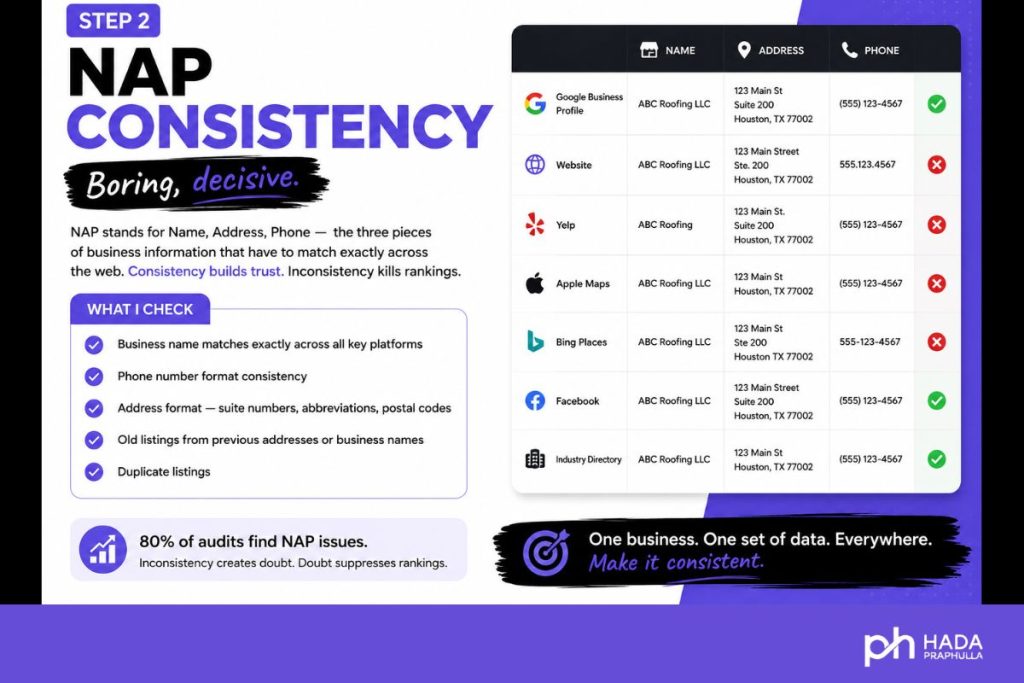
NAP stands for Name, Address, Phone — the three pieces of business information that have to match exactly across every directory where your business appears. Google uses consistency as a trust signal. Inconsistency creates doubt. Doubt suppresses rankings.
What I check:
- Business name matches exactly across GBP, the website footer and contact page, Yelp, Apple Maps, Bing Places, Facebook, and the top 10–15 industry directories. You can use the keyword on the GBP name but it should reflect on all your online footprint.
- Phone number format consistency — even “(555) 123-4567” vs “555.123.4567” gets flagged by some systems.
- Address format — suite numbers, abbreviations, postal codes.
- Old listings from previous addresses or previous business names.
- Duplicate listings — surprisingly common, especially for businesses that have moved or rebranded.
What I find 80% of the time: Three to five inconsistencies across major directories. At least one duplicate GBP listing the owner didn’t know existed. Old citations pointing to an address the business left two to four years ago. Phone numbers that vary because the owner updated some directories but not all.
NAP cleanup isn’t glamorous work. It also isn’t optional. A roofer in Houston with five conflicting addresses across the web is telling Google, in effect, that there are five different roofing businesses with similar names. Pick one. Make it consistent. Stop confusing the algorithm.
Step 3: Location pages and service pages – usually the weakest layer
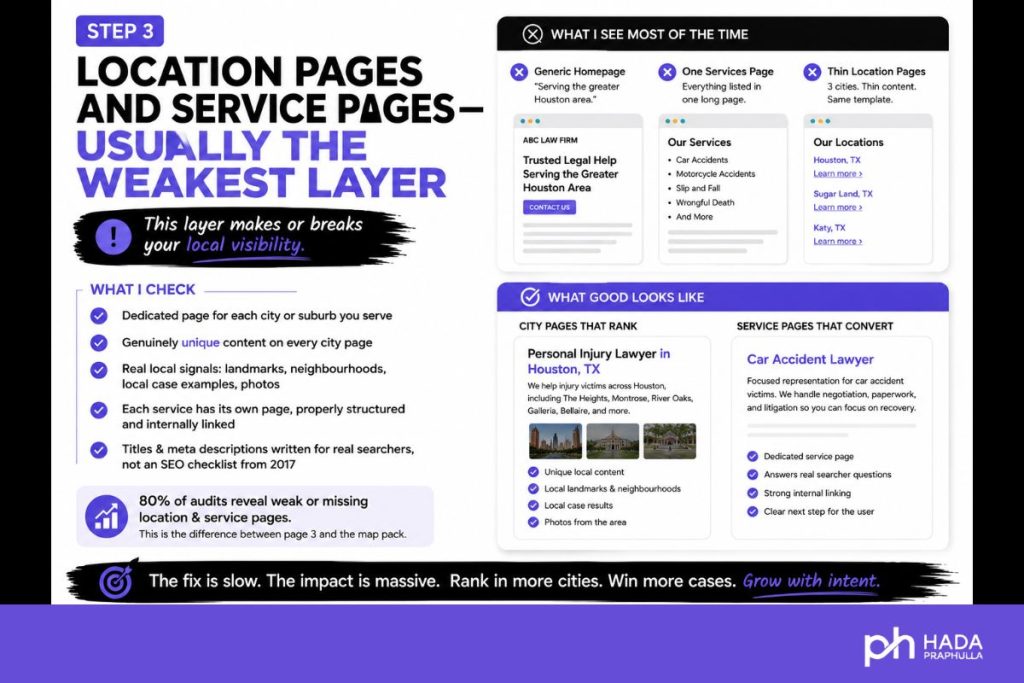
For US service businesses, this is where most websites collapse under inspection. The same pattern repeats:
- One generic homepage that says the business “serves the greater [city] area.”
- A single “Services” page that lists everything in one block.
- Maybe a “Locations” page with three city names linked to thin pages.
What I check:
- Is there a dedicated page for each city or suburb the business claims to serve?
- Does each city page have genuinely unique content — not just the city name find-and-replaced into a template?
- Does the page contain real local signals: landmarks, neighbourhoods, local case examples, photos from that area?
- Does each service have its own page, properly structured, internally linked from the homepage?
- Are page titles and meta descriptions written for a real searcher, or for an SEO checklist from 2017?
What I find 80% of the time: Either no city pages at all, or 20–50 city pages built from the same template with the city name swapped in. Google’s February 2026 Discover core update specifically demoted this pattern. The thin-template city page that worked five years ago is now actively hurting rankings.
For service pages: usually a single “Services” block instead of one page per service. So a personal injury firm with car accident, motorcycle, slip-and-fall, and wrongful-death cases is competing for all four with one mediocre page. That isn’t how this works.
The fix is slow but it’s the difference between ranking in three cities and ranking in fifteen.
Step 4: Technical SEO – rarely the bottleneck, but the things that matter, matter a lot
Most local service businesses don’t have catastrophic technical issues. WordPress is doing its job. The site loads, indexes, mobile mostly works. What I’m looking for is the small set of technical issues that actively suppress local visibility.
What I check:
- Core Web Vitals on the homepage and key service pages — specifically on mobile.
- Mobile rendering: does tap-to-call work? Is the GBP map embedded? Is the menu usable?
- Schema markup: is there LocalBusiness schema with the right type (Attorney, Dentist, HVACBusiness, Roofer)? Service schema on service pages? FAQPage schema where there are FAQs? Note: FAQ schema is now deprecated. Still we can use them to help under the FAQs better to the search engines.
- Indexation: are pages indexed that shouldn’t be? Tag archives, author archives, search results, staging URLs?
- HTTPS, canonical tags, no rogue noindex tags on important pages.
- Crawl errors in Search Console.
What I find 80% of the time: No schema markup at all, or generic Organisation schema instead of the specific business-type schema. Mobile LCP between 3 and 5 seconds because of an oversized hero image. A Contact page with the phone number embedded in an image instead of text. Tag pages or attachment pages getting indexed and diluting the site’s local signal.
The schema gap is the costly one. Without proper schema, your business is invisible to AI Overviews and Ask Maps — the two surfaces that increasingly decide whether a high-intent searcher ever sees you.
Step 5: Reviews – the new prominence signal
Google’s local ranking has shifted in 2026. Real-world engagement now weighs as heavily as backlinks, sometimes more. The single strongest engagement signal a service business can generate is a steady, recent stream of Google reviews.
What I check:
- Total review count and average rating.
- Velocity: how many new reviews in the last 30, 60, 90 days?
- Recency: when was the most recent review? If it’s more than a month ago, that’s a problem.
- Response rate: is the business responding to reviews? Within how long?
- Review content: generic (“great service”), or specific about services, locations, or staff names?
- Off-Google review surfaces: Yelp, Facebook, BBB, Avvo (for lawyers), Healthgrades (for medical), Houzz (for contractors).
What I find 80% of the time: A burst of reviews from one campaign 8 months ago, then nothing. Or a slow trickle that averages one or two per quarter. Owner responses on positive reviews only — negative reviews ignored. Generic reviews with no service or location specifics, which Google’s algorithm now weights lower in citation decisions.
The fix here is operational, not technical. A working review-request process — built into the customer journey, sent at the right moment — beats every other SEO tactic on this list for ranking impact. A roofer who closes a $40,000 job and doesn’t ask for a review at the moment of payment is losing two compounding things at once: the review, and the ranking signal the review would have produced.
Step 6: Local authority – backlinks that actually count
Backlinks still matter, but for local service businesses, only certain kinds count. A link from a high-DA national site that has nothing to do with the city or service does almost nothing for local rankings. A link from a smaller, locally relevant site can move the needle.
What I check:
- Total referring domains — but more importantly, the local relevance of each.
- Links from Chamber of Commerce, Better Business Bureau, local business associations, local news, local sponsorships, local events.
- Links from industry-relevant sites: state bar association directories for lawyers, dental association sites for dentists, trade association sites for HVAC and roofing.
- Toxic links — paid link networks, spam directories, link wheels from 2014 that someone never cleaned up.
- Internal linking: does the homepage link to city pages? Do service pages link to relevant blog content? Do blog posts link back to service pages?
What I find 80% of the time: Almost no local links at all. The backlink profile is either empty or stuffed with low-quality directory submissions from a freelancer who promised “100 backlinks for $50” three years ago. No internal linking strategy — pages are isolated islands. The most common single fix here is getting the business listed on three to five legitimately local sites (Chamber, an industry association, a local news mention). That alone often produces more ranking lift than 100 garbage directory submissions ever did.
Step 7: AI search visibility – the 2026 audit step almost no one is running
This is the newest layer, and the one that separates audits run in 2026 from audits run in 2023. AI Overviews and conversational AI search (ChatGPT, Perplexity, Google’s Ask Maps) now influence a meaningful share of high-intent local searches. The signals these systems rely on overlap with traditional SEO — but not perfectly.
What I check:
- Does the business appear in AI Overviews for its key local queries? If yes, what is it being cited for? If no, who is, and what do they have that this business doesn’t?
- Does ChatGPT recommend the business when asked for “best [service] in [city]”? Perplexity? Does Gemini surface it in Ask Maps?
- Schema completeness — AI systems heavily weight structured data when deciding who to cite.
- Content depth on the site: do service pages actually answer the questions a real customer would ask, or are they marketing copy with no information density?
- Author and expertise signals: is there an About page that establishes the owner as a real, identifiable expert? Are there author bios on blog posts?
What I find 80% of the time: No AI visibility at all. The business has never appeared in an AI Overview for its target queries, and the owner doesn’t know how to check. No structured author or expertise signals. Content that’s optimized for an algorithm from 2018 – keyword density, exact-match headings — and provides almost no actual information to the reader.
The 2026 reality: a local business that ranks number four in the traditional local pack but gets cited in the AI Overview above it will out-convert the businesses ranked above it. Most service-business owners don’t yet realise this. The ones who optimise for it now will have a 12–18 month head start.
What to do next
If you’re a service business owner reading this and you recognised your own setup in three or more of the seven steps, you have an audit problem – not a strategy problem. You don’t need more SEO services. You need to know what’s actually broken and what order to fix it in.
If you want me to run this exact audit on your business, get in touch via the contact page. I work with US and Australian service businesses – law firms, dental practices, HVAC, and similar local service categories.
If you would rather DIY the audit, work through the seven steps in order. Don’t skip ahead. The order matters: GBP fixes show up in 2–4 weeks, NAP cleanup in 4–8 weeks, content and authority work in 3–6 months. Sequencing the work this way means you see early wins that fund the longer-term effort.
The biggest mistake I see service businesses make isn’t picking the wrong tactics. It’s running a half-audit, fixing whatever feels urgent, and missing the two or three issues that actually explain why they’re not ranking. The seven-step order exists for a reason.